THE STORY BEHIND THE CONGO NOVEL SERIES
How a life, a memory, and a vow became an epic literary saga
I was born and raised in the Democratic Republic of Congo — once known as Zaire — in a land where stories are carried in the wind, in the river’s breath, and in the voices of elders who speak for those history tried to silence. When I came to the United Kingdom in the early 1990s as an international student, I carried those stories with me, though I did not yet know they would one day become a novel series.
My journey in the UK was not easy. I arrived with hope and ambition, determined to complete my studies. But soon, financial hardship struck. My father could no longer support my education, and I was forced to leave university and search for work. I still remember the day I was offered a job — a moment of relief — only to be told later that the offer had been a mistake.
That moment broke something inside me. The loneliness of living abroad without my parents, without my siblings, without the familiar warmth of home, became overwhelming. Depression settled in, and I began writing simply to survive — to express what it felt like to be far from everything I loved.
I didn’t know it then, but those private writings were the first seeds of a story that would one day grow into Congo: Spirit of Darkness and the entire Congo Novel Series.
A Legacy for My Children — and for Congo
The second reason I wrote this novel was deeply personal. I wanted to leave a legacy for my children — Jacob and Winnie — and for my nephews and nieces in the UK, the USA, and across Africa. I wanted them to know where they came from. I wanted them to understand the history that shaped our people, the pain that forged our resilience, and the beauty that survived despite everything.
At that time, I could not afford to take my children back to Congo. So instead, I brought Congo to them — through stories told at night, through memories shared at the dinner table, through the voices of ancestors carried in my words.
I told them about the people of Congo who had suffered under colonial rule, who had been victims of human trafficking, who had lost access to basic necessities because of civil unrest. I told them about courage, about survival, about dignity. And slowly, those stories became chapters.
Congo: Spirit of Darkness focuses on the historic slavery of the 1800s, but its purpose is not only to recount the past — it is to raise awareness, to spark conversation, and to remind the world of the continued pillage of Congo’s people and resources.

Returning Home — Researching the Truth. A Journey Into Congo’s Living Memory
In the year 2000, I returned to the Democratic Republic of Congo to visit my parents. But I also returned with a mission: to deepen the novel through real, ancestral research — the kind that cannot be found in books, only in people.
I travelled through villages in the Lower Congo, walking paths carved long before colonial borders existed. I sat with elders beneath mango trees, listening to voices that carried centuries of memory. I met village chiefs who guarded stories passed down through bloodlines. I recorded oral histories spoken in Kikongo — stories that had never been written, only remembered.
I collected written documents, testimonies, and fragments of history preserved in notebooks, church archives, and family trunks. But it was the oral testimonies that changed me most. They allowed me to see the truth of slavery through the eyes of the people who lived it — not through textbooks, but through lived experience.
I heard voices trembling as they recalled the terror of the Congo Free State. I heard mothers speak of children taken. I heard elders describe the burning of villages, the hunger, the fear, the silence that followed. I heard stories of resistance, of courage, of spiritual strength that refused to die.
These interviews did more than inform the novel — they transformed it.
They gave me access to a truth that only a native son of Congo could receive: a truth spoken in the rhythm of Kikongo, in the pauses between sentences, in the tears that fell when words were too heavy to carry.
Using these real historical events, I shaped an epic fictional story that honours their voices — a story built not from imagination alone, but from the living memory of Congo’s people.

What Makes This Novel Truly Unique
What makes the Congo Novel Series profoundly unique is this:
It is written by a native Congolese author who returned home to gather oral testimonies from Congolese people who lived the history.
This is not a story imagined from afar. It is not reconstructed from Western archives. It is not filtered through foreign interpretation.
It is a story born from:
- Congolese voices
- Congolese memory
- Congolese pain
- Congolese resilience
- Congolese ancestral truth
Every chapter carries the authenticity of a writer who grew up on Congolese soil, who speaks the language, who understands the culture, who knows the rhythm of the land and the silence of its wounds.
Every scene is shaped by testimonies gathered facetoface — not through documents, but through human experience.
This makes the novel not only a work of fiction, but a literary preservation of Congo’s oral history.
It is a bridge between generations. A vessel of memory. A tribute to voices that were almost lost. A story only a Congolese writer could tell.
A Manuscript Found — and a Brother’s Support
Years later, my brother Mayi Ngwala discovered the manuscript. He believed in it immediately. He supported me, encouraged me, and eventually became my coauthor.
With his help, Congo: Spirit of Darkness was published on November 26th, 2012.
Soon after, something extraordinary happened.
Our book was nominated for the 44th NAACP Image Awards in the USA for Outstanding Literary Work — Debut Author.
We received the news during a live press conference in Beverly Hills. It was a moment I will never forget — a moment that told me the story of Congo mattered, not just to me, but to the world.
The NAACP Image Awards — A Moment of Recognition
The NAACP Image Awards is one of the world’s most respected multicultural awards ceremonies. It celebrates the achievements of people of color in television, music, literature, and film, and honors individuals and groups who advance social justice through creative work.
Its stage has welcomed icons such as Jennifer Hudson, Harry Belafonte, Samuel L. Jackson, Vanessa Williams, and Lenny Kravitz — artists whose voices have shaped culture and history.
To stand among such names was never something I imagined when I first began writing in a small room in the United Kingdom, far from home, trying to make sense of loneliness and memory. Yet there we were — two brothers from Congo — carrying a story born from ancestral truth.
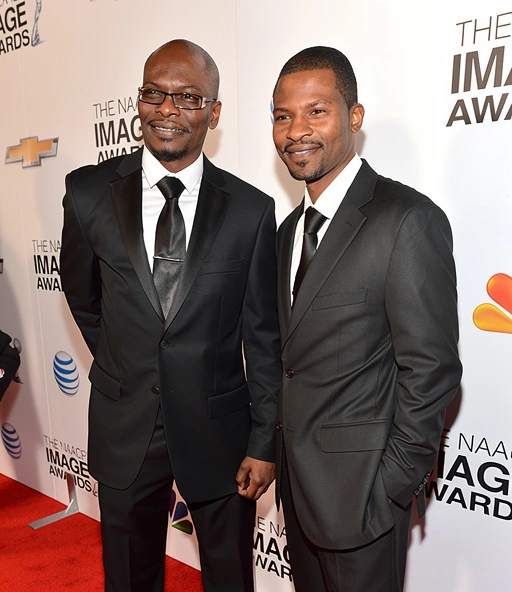
At the NAACP Image Awards – Allain Ngwala on the left and Mayi Ngwala on the right.
The Expanded & Illuminated Edition
The definitive opening to the Congo Novel Series
Today, I am launching the Expanded & Illuminated Edition of Congo: Spirit of Darkness — the version that finally reflects the full vision I always intended.
This edition is not simply revised. It is reborn.
It includes:
- new chapters
- deeper character arcs
- expanded worldbuilding
- archival sketches and historical notes
- new spiritual and ancestral layers
- refined narrative structure
- enhanced emotional depth
Every scene has been sharpened. Every character has been given greater dimension. Every thread now connects seamlessly to the volumes that follow — Congo: Tears of Darkness and the future books of the saga.
For returning readers, this edition reveals new colours, hidden edges, and deeper truths within the story you already love. For new readers, this is the beginning — the doorway into a world where history, myth, and ancestry walk side by side.

Susanne Treacher, right, the inspiration behind the character “Susan Bailey Dawson”, the soul of my novel. She is sitting with daughter Winnie Paris Palmer.
The Inspiration Behind Susan Bailey Dawson
Every epic story has a soul — a single presence whose spirit shapes the emotional core of the narrative. For the Congo Novel Series, that presence is Susan Bailey Dawson.
Her character was inspired by Susanne Treacher — the mother of my children, a woman whose strength, honesty, and unwavering friendship carried me through the darkest and brightest moments of writing this saga. Susanne did not simply encourage me; she became the emotional compass of the novel. Her resilience, her compassion, and her fierce commitment to truth breathed life into Susan Bailey Dawson.
To Susanne Treacher: Your spirit shaped Susan. Your courage breathed life into her. Your truth guided the emotional core of this novel. You stood beside me from the first spark of an idea to the final written word.
Who Susan Is in the Story
In the novel, Susan Bailey Dawson begins as a young Englishwoman documenting her early encounters in the Congo. Her journal — still inked with the innocence of observation — becomes the doorway through which readers enter the world of the Congo Free State.
But as she travels deeper upriver, she crosses a threshold where myth and reality blur.
What she witnesses is no longer just history. It becomes personal. It becomes spiritual. It becomes a calling.
She sees villages burned. She meets families torn apart. She hears stories carried by the river that no pen can fully contain. She becomes entangled in the widening brutality of King Leopold II’s ambitions — a darkness that transforms her life and her legacy.
Susan is not merely a character. She is a bridge — between continents, between eras, between the living and the ancestral world.
Why Susan Matters
Susan Bailey Dawson represents:
- the outsider who becomes a witness
- the witness who becomes responsible
- the responsible who becomes transformed
She is the character through whom readers experience the Congo’s truth — not as distant history, but as lived reality.
Her journey mirrors the journey of anyone who has ever stepped into a world they did not understand, only to discover that the world was waiting for them.
She is the embodiment of:
- empathy
- awakening
- courage
- transformation
And she is the literary echo of Susanne Treacher — the woman whose spirit helped bring this entire saga to life.
How Susan Connects to the Pact
Susan’s role in the story is not accidental. She becomes one of the carriers of the Pact, the sacred matrilineal thread forged by Boali, Mpende, and Nsala.
The Pact travels:
Boali → Papa Kiala → Susan → Elizabeth → Layila’s lineage
Susan is the first nonCongolese woman to hold the thread. She becomes the bridge through which the ancestral vow crosses continents and generations.
Her journal becomes the vessel of memory. Her compassion becomes the doorway through which the ancestral world speaks. Her transformation becomes the proof that the Pact is not bound by blood — it is bound by truth.

“The real Pact — Ma’ Paku Bodi Alexandrine Fifi, in the middle — the inspiration behind Boali, the elder root of the Congo universe. The matriarch whose strength, dignity, and ancestral presence shaped the soul of my novel. Auntie Vicky, on the left — the inspiration behind Mpende, the grieving flame. Her strength carved from sorrow and her courage shaped the emotional fire of the Congo story. Auntie Henriette, on the right — the inspiration behind Nsala, the quiet protector. Her steady love, gentle strength, and daily devotion shaped the heart of the Pact.”
The Real Pact — My Family, My Bloodline, Your Story
The women of my novel — Boali, Mpende, Nsala — are never just characters. They are reflections of the real matriarchs who shape my life and my identity.
Ma’ Paku Bodi Alexandrine Fifi — my mother — is the living inspiration behind Boali, the elder root. Her strength, dignity, and ancestral presence form the foundation of the Congo universe.
Auntie Vicky — in her traditional attire — is the reflection of Mpende, the grieving flame. Her courage forged through sorrow shapes the emotional fire of the story.
Auntie Henriette — calm and steady — is the heart behind Nsala, the quiet protector. Her gentle devotion and daily strength give life to the nurturing spirit of the Pact.
Together, they are the real Pact — the matrilineal thread, the ancestral forest made flesh, the unbroken lineage that inspires every page of the Congo Novel Series.
My story lives because it carries their legacy. My universe breathes because it carries their truth.
Why Susan’s Inspiration Makes the Novel Unique
Dawson was inspired by a real woman who walked beside the author, who listened, who encouraged, who believed.
This gives Susan a depth rarely seen in fiction:
- She is grounded in real friendship.
- She is shaped by real emotional truth.
- She is connected to the author’s own journey.
- She is a fusion of lived experience and ancestral storytelling.
Her character is not an invention — she is an honoring.
The Inspiration Behind Layila
The character of young Layila reflects not only the children of Congo — but also my own journey and the millions of young people who have been left to survive life’s challenges alone, without the support of family.
When I came to the UK, I faced cultural shock, language barriers, isolation, and a lifestyle completely different from the African ancestral world. Layila carries that same loneliness — that same fight for identity — that same longing for home.
Far from her world, Layila stands at the threshold of womanhood, shaped by loss and sharpened by survival. Her path winds through sacred groves, hidden sanctuaries, and the whispered teachings of elders who refuse to let their people’s memory be extinguished.
Through her eyes, the ancestral world breathes: gods of fire and water, guardians of forest and sky, and spirits who rise when the living can no longer bear their grief alone.
Layila is not just a character. She is a mirror — of me, of Congo’s youth, of every child who has had to grow up too soon.
The Inspiration Behind the Pact
The Pact — also called the thread — was inspired by three women in my own life: my mother Ma’ Paku Bodi Alexandrine Fifi (Madame Ngwala, Mère Double) and her two sisters, Henriette and Vicky.
Growing up, I witnessed in them:
- A vow of survival forged under fire, hunger, and the shadows of colonial brutality.
- A vow of memory to keep names, stories, and proverbs alive.
- A vow of protection to safeguard children and future generations.
- A vow of identity to preserve the matrilineal thread even when the world tries to erase it.
- A vow of return to carry the forest, the fig grove, and the ancestral land inside them — wherever they go.
These women were the living embodiment of the Pact. Their strength became the foundation of the story.
THE PACT — A Sacred Matrilineal Vow
In the novel, the Pact is a sacred, intergenerational vow forged by three women during the terror of the Congo Free State era. Born in fire, grief, and defiance, it becomes the spiritual backbone of the entire saga.
The Pact is:
- a promise of protection
- a commitment to preserve identity and memory
- a maternal oath to safeguard children at any cost
- a thread that binds generations together
From its origin beneath the burning fig grove, the Pact travels across time and continents — carried from Boali → Papa Kiala → Susan → Elizabeth → Layila’s lineage. It is the emotional engine of the story, the hidden thread connecting past and present.
The Original Circle — The Three Women Who Made The Pact
The character of young Layila reflects not only the children of Congo — but also my own journey and the millions of young people who have been left to survive life’s challenges alone, without the support of family.
When I came to the UK, I faced cultural shock, language barriers, isolation, and a lifestyle completely different from the African ancestral world. Layila carries that same loneliness — that same fight for identity — that same longing for home.
Far from her world, Layila stands at the threshold of womanhood, shaped by loss and sharpened by survival. Her path winds through sacred groves, hidden sanctuaries, and the whispered teachings of elders who refuse to let their people’s memory be extinguished.
Through her eyes, the ancestral world breathes: gods of fire and water, guardians of forest and sky, and spirits who rise when the living can no longer bear their grief alone.
Layila is not just a character. She is a mirror — of me, of Congo’s youth, of every child who has had to grow up too soon.
Boali
The eldest of the three. A woman of deep intuition and ancestral knowledge. She replants the fig grove even after it is destroyed. She becomes the first keeper of the thread — the diplomat, the voice of leadership.
Mpende
The grieving mother whose loss becomes the moral spine of the vow. Her endurance and sorrow give the Pact its emotional weight. She embodies its central teaching: “Do not abandon what you have chosen.”
Nsala
The calm, protective mother of Layila, Nsimba, and Nzuzi. Her wisdom anchors the Pact in everyday life. Through her children, she carries the vow forward — grief transformed into resilience.
Together, these three women form the original circle — the matrilineal source from which the Pact flows into every generation that follows.

Why This Story Exists
The Congo Novel Series is more than fiction. It is a vessel of memory. A tribute to resilience. A testament to the voices history tried to silence.
It was born from pain, from longing, from ancestral guidance, and from love. It has grown into a saga recognized across continents — from Congo to the United Kingdom, from the BBC to the NAACP Image Awards.
And now, with the Expanded & Illuminated Edition, the journey begins again.